
Our Collection
The New Zealand Portrait Gallery’s permanent collection of works is growing as portraits are donated and sponsored.
As part of an ongoing project to share more about the works in our collection, our 2026 Museum and Heritage Practice intern, Abi Lapthorn, has selected a number of portraits to research and explore. We invite you to learn more about the stories, subjects, and artists behind these works by reading the articles below.
Susan Wilson, Witi Ihimaera, 2014. Oil on Linen. Collection of the New Zealand Portrait Gallery. Donated by Susan Wilson

Portrait of Witi Ihimaera painted at the Maritime Museum Oslo at the New Zealand Association Conference in 2014.
Witi Ihimaera (Te Aitanga-a-Māhaki, Rongowhakaata and Ngāti Porou) is a pioneering voice in Aotearoa New Zealand literature, vastly recognised as the first Maori author to have published in a western context both a short story, Pounamu Pounamu, 1972, and a novel, Tangi, 1973. Ihimaera is a singular voice, offering a perspective that is uniquely Māori. A celebration of the rural world he grew up in, the process of rural to urban migration showing Māori engaging in a Pākeha metropolitan worldview, and intergenerational language loss. Writing from a semi autobiographical lens as he returns time and time again to the setting of his childhood home of Waituhi, Gisborne. Writing about the people that he knows and a life that he loves very much.
The artist Susan Wilson is a New Zealand expatriate living and working in the UK. Before painting people, Wilson maintains that she needs to get to know her portrait subject. When it came to Ihimaera she felt she needed to read more of his work, “I cannot paint Witi without doing background reading, I have to know more about him” (Standing Room Only - RNZ, 2015). The conversations she has with her sitters and encourages them to have in her studio are vital to the outcome of the painting. Explaining that all of the dialogue goes into the work. To know people is to have their personal essence shine through in the piece. The same can be said as to why Ihimarea is always returning to Waituhi. To paint someone or to write about something so personally, is to reveal what you see. In this way their mediums complement each other in their pursuits to capture deeply human experiences that connect us through storytelling.
Self described, Wilson is not into painting flattering images and in turn the result she often finds is an appreciation for the honesty that becomes visible on the canvas. The style of portraiture is something that is so unmistakable in its bluntly candid technique, showing the humanity in Ihimarea’s face. Evident brush strokes and distinct colour changes muddle the lines of a realistic face, bordering on a more expressionist approach to portraiture.
Freeman White, Dame Alison Holst, 2011. Oil on Canvas. Collection of the New Zealand Portrait Gallery.
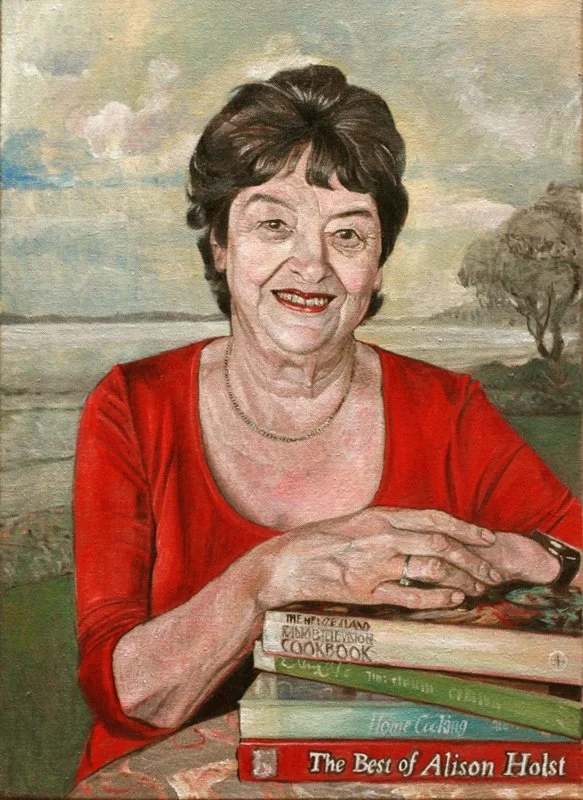
In the New Zealand Portrait Gallery permanent collection you will find stories of individuals who have shaped the fabric of this country in multiple different ways. This portrait of Dame Alison Holst stands out as a person who has helped significantly change the way we have come to know ourselves through her influence on the domestic kitchen and food.
Cookbook author and Aotearoa’s first celebrity chef Alison Holst was a large part in adapting the way the country's taste evolved throughout the 1960s helping a generation of home cooks adventure away from dull uniformity. Her influence on food introduced not only a progression of fusion taste with the likes of ‘Greek’ or ‘Chinese’ inspired recipes that were inexpensive and easy; she also brought technological advancements into the kitchen with the likes of microwave meals and crockpot recipes. Her concern was primarily for the ordinary household and busy mother, which is found in her cooking's simplicity and accessibility of everyday ingredients.
Dame Alison Holst was born in Dunedin in 1938. She went to Otago to get her Bachelor of Home Science. After graduating she spent a year at Teachers College where she then went on to lecture in the Food Department at the School of Home Science. This teaching career would only last a short while as her first TV program as a budding celebrity chef would burst on to screens in 1963. This was then followed by her first cookbook, Meals with the Family, in 1967 which is held in the Museum of New Zealand Te Papa Tongarewa’s history collection due to its significance on modern society.
In her portrait she stands front and centre in the composition. The bright red colour, evident in her blouse and book, are striking. Behind her is a beach scene on a cloudy day, the environment emphasising a laid back domestic New Zealand lifestyle. In the foreground are a stack of cook books that you are likely to find well-loved and worn copies of in your mothers’ or grandmothers’ cupboards. Most notably, the iconic covers of The Best of Alison Holst, 1991, and Alison Holst: The Ultimate Collection, 2000. The portrait was painted by Freeman White in 2011 for an exhibition at the New Zealand Portrait Gallery called, Makers of Modern New Zealand: 1930-1980: The Men and Women who Shaped Our World. The show explored sixty people who had contributed significantly to the fast-evolving time period.
Matt Grace, Gregory O’Brien and Jenny Bornholdt (After Robin Morrison), 2015. Ink jet print on archival paper. Collection of the New Zealand Portrait Gallery Te Pūkenga Whakaata.
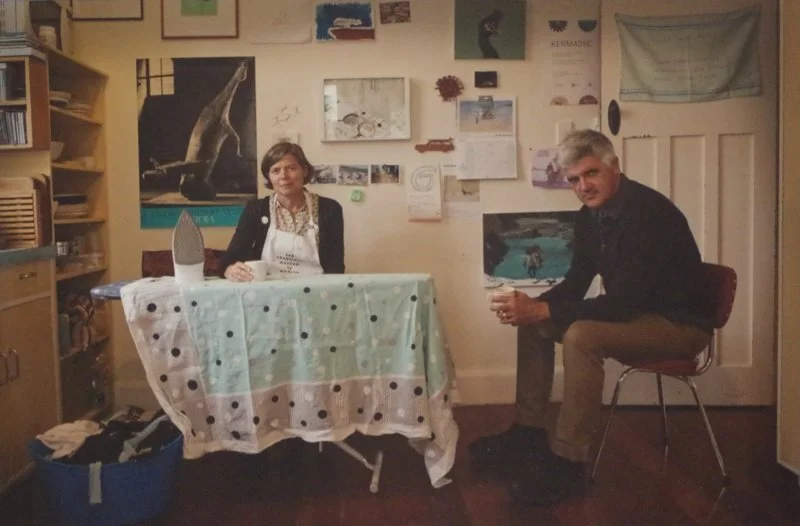
A couple sits in their kitchen, eyes looking directly into the lens of the camera. The woman sits on a chair behind an ironing board, a polka dot sheet abandoned for now. She has what I imagine is an evening mug of tea. She looks relaxed and familiar in the setting, a kitchen full of life and busyness. To her left sits her partner in a chair, lent forward with his arms resting on his knees holding a mug for himself. The photograph is an image of domestic life, showcasing an interior of a home that sees the intimate and mundane moments that make us who we are. The memorabilia that decorates the walls is as much a portrait as the sitters’ faces are. The posters, photographs, paintings, teatowel, hand drawn notes, washing basket and art pieces all speak to what is important to them, makes up their identities and signals their place in the world.
The pair are creative Pōneke Wellington couple Gregory O’Brien and Jenny Bornholdt in their family home in Hataitai. O’Brien is a poet, painter, author, and curator who has a presence in both the art and literature worlds in Aotearoa New Zealand. He has published extensively over a range of genres including, art history, poetry, and short stories. Bornholdt is an accomplished and prolific poet and anthologist. She was New Zealand’s poet laureate from 2005 to 2007 and has been a recipient of several fellowships and awards. Together they are a creative and enduring force.
This photo was taken by Matt Grace. He was raised in Wadestown, Wellington, and now lives in Auckland. His work includes commercial and advertising photography such as promotional film stills. In this image he takes a more artistic approach when setting a scene of his own and capturing this moment. The title of the work is a nod to documentary photographer, Robin Morrison (1944-1993) and his photograph, Jane and Ted Lawrence, Bannockburn, 1979. If Grace's reference is a mirror, Morrison’s original is the window into the domestic interior.
Jacqueline Fahey, Girl Dreams, 1979. Oil on board. Collection of the New Zealand Portrait Gallery Te Pūkenga Whakaata. Gifted by the Adam Foundation.
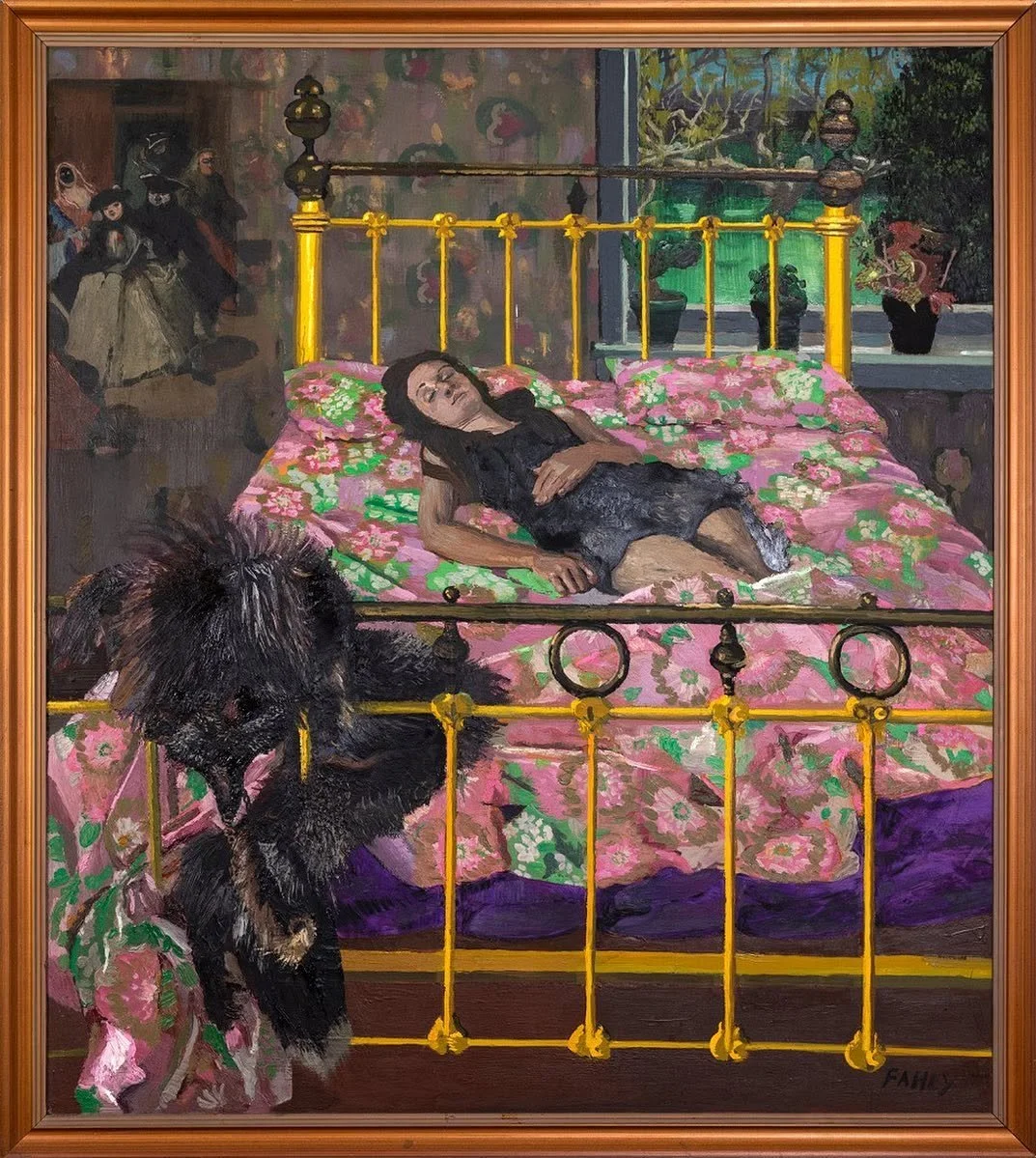
A young woman lays in her bed, still wearing her dress from a night gone by. There is a large coat thrown haphazardly at the end of the bed, dangling from the ornate gold frame. There is a sense of collapse, as if her tiredness was too much to bear before she fell back into the beds inviting warmth. In the left corner there is a box of porcelain dolls on a shelf, cast slightly into shadow. It feels as though they are being packed away and time is moving on from them. The bittersweet departure of girlhood lingers here. Despite the melancholic nature of the image there is still a lot of life. The vibrancy of the pink and purple bedsheets and the electric looking green grass outside the window creates an impression of youthful assuredness towards the future.
This moment was captured by the young woman's mother, renowned artist Jacqueline Fahey, and examines her feelings about her daughter entering into this new stage of life– exploring womanhood and the experience of venturing out into nightlife. Much of her work is informed by personal experiences, events, family, friends, love and loss in her life. Domestic life becomes an intensely invigorating subject to be examined, enjoyed, and questioned through her brush.
Jacqueline Fahey was born in Timaru, Aotearoa New Zealand in 1929. She attended The Canterbury College School of Arts in Ōtautahi Christchurch and received a diploma in Fine Art in 1951. After graduating she left South Canterbury behind, moving to Wellington the very same year. Shortly after moving she met her husband and moved to Porirua where they raised their three girls. Here, she painted from the kitchen table, the living room or wherever she could get her canvas. She was adamant about,“[n]ot resisting the circumstances of my domestic life but incorporating it into my work.[...] use it to contribute to my painting”. Becoming a mother wasn’t the end for Fahey’s creative career, it was only the beginning.
During this time of living in the suburbs and raising young girls she worked on a series given the name Suburban Neurosis from the 60’s and 70’s. These works were in part an articulation of her second wave feminism. However, most strikingly, they depicted the ordinary lives of women and housewives living in the suburbs, experiencing isolation and depression. She was interested in capturing the claustrophobia of the female experience, writing in her 2006 memoir, Something for the Birds, “My interest was in the fate of women, how domestic circumstances dictated their lives”. Fahey’s close attention to the experiences of women, capturing candid portraits of the human condition and feeling, showed the ways in which we become entangled with the everyday lives of people around us.
1. University of Otago Magazine, Issue 9, October 2004, p. 40.
2. Fahey, Jaqueline, Something For The Birds, Auckland University Press, 2006.